


Coedee Field Notes
The Shift In One Line
Humanoid robotics has quietly moved from “impressive demo” to “committed production line,” and the AI running inside these machines just got a major upgrade.
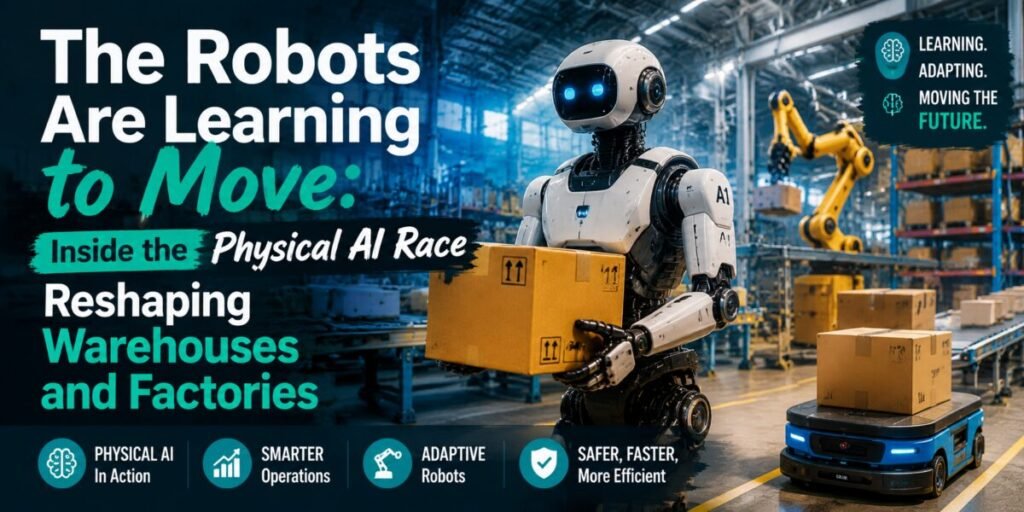
For years, humanoid robots lived in a strange purgatory of viral videos and vague promises. A robot would backflip on stage, the internet would marvel for a week, and then nothing would ship. That pattern is breaking down in real time. Between new “whole-body” AI models, expanding factory floors, and a wave of fresh capital chasing the category, physical AI is starting to look less like a novelty act and more like an industrial buildout.
Google’s Robots Just Got a Full-Body Upgrade
The clearest signal of where this is heading came from Google DeepMind, which unveiled Gemini Robotics 2, a new model built to let humanoid machines coordinate movement across their entire body rather than treating limbs, balance, and manipulation as separate problems to solve independently. The system extends Google’s Gemini AI technology into the physical world, giving robots the ability to walk, crouch, and manipulate objects while reasoning through multi-step tasks in real time — the difference between a robot that can grip an object and one that can figure out, on the fly, how to approach an unfamiliar object it’s never seen positioned that way before.
That distinction — between programmed automation and genuine adaptability — is the technical frontier the entire industry is racing toward right now. A robot arm that repeats the same motion on a factory line has been solved technology for decades. A robot that walks into a cluttered, constantly changing environment and figures out what to do next is a fundamentally different, and much harder, problem. That’s the gap “physical AI” is meant to close, and it’s the reason a foundation-model approach to robotics, rather than task-specific programming, has become the direction nearly every serious player in the space has converged on.
From Demo to Assembly Line
The production numbers this summer tell a story that’s easy to miss if you’re only watching the flashy reveal videos. Figure AI manufactured its 1,000th Figure 03 humanoid at its BotQ facility in late July, and the company says it’s now producing at a sustained rate of roughly one robot per hour — a manufacturing cadence, not a research pace. Those units aren’t sitting in a lab; Figure has expanded paid deployments including logistics sequencing work at BMW’s Spartanburg plant, building directly on that production milestone.
Chinese manufacturer AgiBot has reportedly reached 15,000 cumulative humanoid robots produced, with active deployments in factory and quality-inspection roles. Unitree, which has quietly become the volume leader in the category, shipped more than 5,500 humanoids in 2025 and is targeting somewhere between 10,000 and 20,000 units this year — reportedly at roughly a tenth of the price of some Western competitors, even as the company’s own profit margins were squeezed in the process. Boston Dynamics’ electric Atlas continues deployments with partners including Hyundai’s robotics arm and Google DeepMind, with the company reportedly having its full production for the year already committed.
The Names You’d Expect Are Moving Slower Than the Ones You Might Not
Tesla’s Optimus program remains the highest-profile humanoid effort in the world, and also, by most independent tracking, the furthest behind its own announced timeline. As of mid-July, production at the retooled Fremont line had reportedly not yet begun, despite earlier guidance pointing toward that milestone. Elon Musk has pushed back publicly on claims that output had quietly started, and Tesla’s most recent quarterly delivery report contained no Optimus figures at all. Analysts tracking the program’s public communications have counted multiple separate production milestones that were delayed or revised before their original target date — a pattern specific enough that near-term Optimus timelines are now widely treated by industry watchers as probabilities rather than commitments.
That gap between headline attention and verified deployment is worth sitting with. The companies actually shipping meaningful unit volume right now — Figure, Unitree, AgiBot, Boston Dynamics — are, with the partial exception of Figure, not the household names dominating the news cycle. It’s a familiar pattern from other hardware categories: the loudest announcement and the fastest actual deployment are frequently two different companies.
The Money Keeps Arriving
Capital is following the production numbers rather than the marketing. Apptronik launched its updated Apollo 2 humanoid in July and simultaneously opened an expanded data-collection and training facility in Austin, purpose-built to generate the enormous volumes of real-world interaction data that these foundation models need to keep improving. Elsewhere, Walden Robotics emerged from stealth mode with $300 million in funding aimed at building robots that continuously learn while performing paid work, and Shenzhen-based AI² Robotics closed a raise of roughly $735 million, pushing its valuation past $2.8 billion and positioning it among the leading players in China’s fast-moving physical AI sector.
Even automakers outside the traditional robotics world are entering the category. BYD has confirmed it will unveil its first humanoid robot in August, joining a growing list of Chinese automakers using their existing manufacturing scale to move into robotics — a strategic logic that mirrors how several EV makers built battery and software expertise that translated directly into robotics ambitions.
What’s Actually Hard, Still
None of this means the category has solved its core problem. Industry engineers are candid that the real bottleneck isn’t building a humanoid shape that can walk — that part is largely figured out. It’s adapting to environments that are constantly changing in small, unpredictable ways: a box that’s slightly heavier than expected, a floor that’s unexpectedly slick, a task that requires reading a situation rather than executing a memorized motion. That’s precisely the problem whole-body foundation models like Gemini Robotics 2 are aimed at, and it’s why the next real leap in the category is likely to come from software improvements running on largely similar-looking hardware, rather than from a dramatically new robot body design.
Why This Matters Beyond Robotics Enthusiasts
For businesses watching from outside the robotics industry, the signal worth tracking isn’t which robot looks the most convincingly human. It’s the intersection of three things happening at once: falling compute costs for training these models, hardware designs that are converging rather than fragmenting, and production numbers that are starting to look like genuine manufacturing rather than pilot programs. When those three lines cross, category adoption tends to move faster than outside observers expect — and based on the numbers from just this past month, that crossing point may be closer than the still-cautious public conversation about humanoid robots suggests.
Not Every Robot Is Built for a Warehouse
Amid the industrial deployment numbers, a different design philosophy has also been quietly gaining attention: robots built specifically for close human contact rather than raw task throughput. Shanghai-based DroidUp unveiled Moya, a roughly 5.5-foot, 70-pound humanoid designed for social proximity rather than athletic feats, featuring silicone skin, internal padding arranged to mimic body warmth in the 90-to-97-degree range, and an artificial spine that lets its torso twist more naturally than a rigid industrial frame would allow. Cameras in each eye track a person’s face and expression and mirror them back, aiming for a presence that reads as attentive rather than mechanical.
The tradeoffs are real and worth naming honestly: lifelike skin and warm, deformable surfaces add cost, fragility, and regulatory complexity that a purely functional warehouse robot doesn’t have to deal with. But the existence of two clearly diverging design philosophies — rugged, task-optimized machines for logistics versus soft, socially-tuned machines for companionship or caregiving contexts — suggests the category is starting to fragment by use case rather than converging on one universal robot shape, much the way computing hardware eventually diversified from general-purpose machines into task-specific form factors.
That fragmentation is worth watching closely over the next year, because it implies the humanoid market won’t resolve into a single winning design the way some early coverage of the category assumed. A logistics operator optimizing for uptime and payload capacity has almost nothing in common, functionally, with a care facility optimizing for a resident’s comfort and trust. The companies that eventually win each of those lanes may end up looking less like competitors to one another and more like separate industries that happen to share a two-legged form factor and a foundation-model approach to control.
A Reality Check Worth Keeping in Mind
It’s worth treating headline unit-count claims in this sector with a healthy amount of skepticism, because the gap between what gets reported and what companies actually confirm can be significant. Widely circulated figures — Tesla having passed 50,000 cumulative Optimus units, Figure surpassing 10,000 deployments across partner warehouses, more than a thousand robots supposedly working Tesla’s own production lines — do not hold up against the companies’ actual public filings and statements. None of those specific figures have come from the companies they describe. The verified numbers are more modest and, in some ways, more meaningful precisely because they’re confirmed: Figure’s audited 1,000-unit BotQ milestone, AgiBot’s reported 15,000 cumulative units, Unitree’s 2025 shipment figures. Readers evaluating claims in this space are generally better served by tracking confirmed production and deployment numbers over viral unit-count claims that rarely trace back to an actual company statement.