


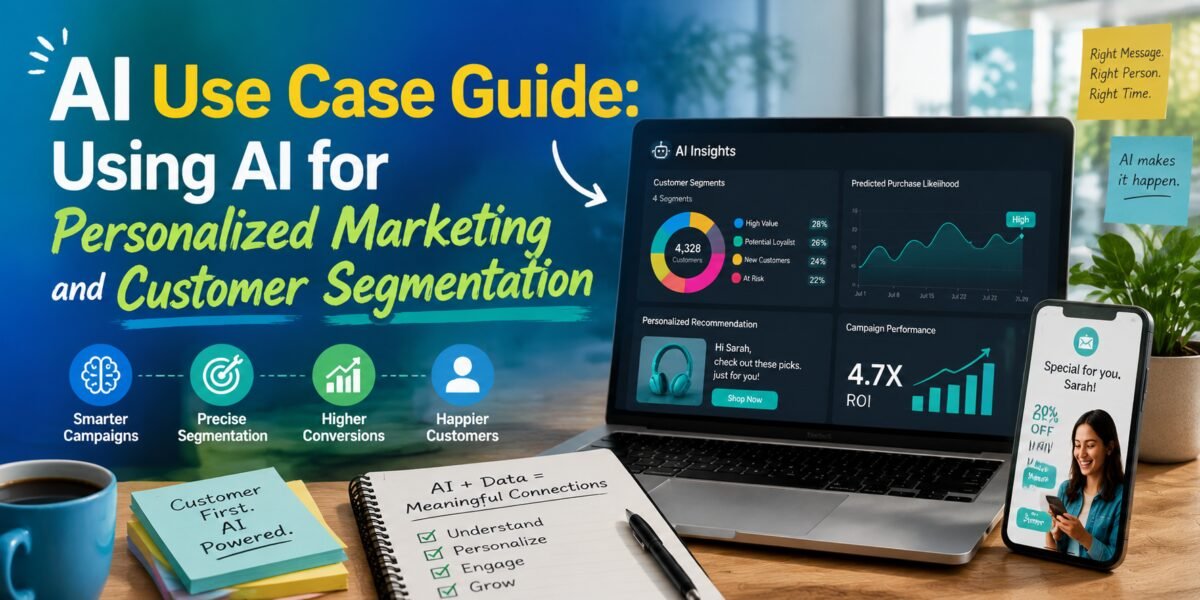
Quick take: Personalization has long been a marketing goal that was easy to describe and hard to execute at scale. AI has closed much of that gap, not by replacing marketing strategy, but by making it practical to segment audiences dynamically, generate tailored messaging variants, and predict which customers are likely to churn or convert. This guide covers the concrete use cases, a step-by-step rollout plan, and the ethical guardrails worth building in from the start.
Why This Use Case Matters
Customers increasingly expect messaging that feels relevant to them specifically, not a generic broadcast. At the same time, most marketing teams don’t have the bandwidth to manually build dozens of audience segments and craft custom messaging for each one. AI changes the economics of personalization: instead of a handful of broad segments, teams can work with much more granular groupings, and instead of one-size-fits-all copy, they can generate and test tailored variants efficiently.
Core Use Cases
1. Dynamic Audience Segmentation
Rather than relying on static segments defined months ago, AI models can continuously re-cluster customers based on evolving behavior, browsing patterns, purchase history, engagement recency, surfacing segments a human analyst might not have thought to define manually.
2. Predictive Churn and Lifetime Value Scoring
AI models can flag customers showing early signs of disengagement before they actually churn, and estimate which customers are likely to be most valuable over time. This lets marketing teams prioritize retention efforts where they’ll matter most, rather than treating every customer the same.
3. Personalized Content and Offer Generation
Once a segment or individual profile is understood, AI tools can generate tailored email subject lines, product recommendations, or promotional offers suited to that specific audience, at a scale that would be impractical to write by hand.
4. Send-Time and Channel Optimization
Beyond message content, AI models can learn each customer’s typical engagement patterns and optimize when and through which channel (email, SMS, push notification) a message is most likely to be seen and acted on.
5. Campaign Performance Prediction
Before a campaign fully launches, AI tools can model likely performance based on historical patterns, letting marketers test and refine creative or targeting choices before committing full budget.
Choosing the Right Approach
| Approach | Best for | Watch out for |
|---|---|---|
| Built-in AI features in your existing marketing platform | Teams wanting quick wins without new tooling | Personalization depth is limited to what the platform supports |
| Dedicated customer data platform with AI segmentation | Organizations with data spread across multiple systems | Requires solid data integration work upfront |
| Custom predictive models | Larger teams with unique business dynamics not well served by off-the-shelf tools | Higher build and maintenance cost; needs data science expertise |
Step-by-Step: Rolling Out AI-Driven Personalization
- Unify your customer data first. Personalization is only as good as the data behind it, fragmented data across disconnected tools undermines everything downstream.
- Start with one high-value use case. Churn prediction for your highest-value customer segment, for example, rather than trying to personalize every touchpoint at once.
- Define your segments’ guardrails. Decide upfront what data is and isn’t appropriate to personalize around, this matters both ethically and for regulatory compliance.
- A/B test AI-generated content against human-written baselines. Don’t assume personalized automatically means better; validate it with real performance data.
- Build a feedback loop. Feed campaign results back into the model so segmentation and messaging improve over time rather than staying static.
- Audit for fairness and relevance regularly. Check that personalization isn’t drifting toward manipulative tactics or excluding segments unfairly.
Quick takeaway: The line between helpful personalization and unsettling surveillance is thinner than it looks, the best-performing programs tend to be transparent about what data drives recommendations and give customers control over it.
Best Practices
- Be transparent with customers about what data informs personalization, and offer opt-outs where appropriate.
- Test AI-generated messaging for tone and accuracy before it reaches customers at scale.
- Prioritize use cases with clear business impact, churn prevention and high-value segment targeting usually deliver faster ROI than broad, shallow personalization.
- Keep humans involved in reviewing edge-case segments, since automated clustering can occasionally produce odd or inappropriate groupings.
- Respect regional privacy regulations when using behavioral or purchase data for targeting.
Common Pitfalls to Avoid
- Over-personalizing to the point of feeling invasive. Referencing very specific behavior can come across as creepy rather than helpful.
- Ignoring data quality. Personalization built on stale or incomplete customer data produces irrelevant or even embarrassing recommendations.
- Treating AI segments as permanent. Customer behavior changes; segments need to be refreshed, not set once and forgotten.
- Skipping human review of generated copy. Automated messaging can occasionally miss context, a promotional email sent to someone who just had a bad support experience, for instance.
Illustrative Example
Consider a subscription meal-kit company that used AI-driven churn scoring to identify customers showing early signs of disengagement, skipped weeks, declining app opens, well before they canceled. Rather than sending the same generic “we miss you” email to everyone, the marketing team used AI-generated, segment-specific offers: a discount for price-sensitive customers, a menu-variety pitch for those who’d flagged repetitive meal fatigue in support tickets. By tailoring both the timing and the message to the likely reason for disengagement, the retention campaign performed meaningfully better than the single generic email it replaced.
Measuring Success
- Conversion rate lift for AI-personalized campaigns vs. generic baselines
- Reduction in churn among flagged at-risk segments
- Customer lifetime value trends across personalized cohorts
- Unsubscribe and opt-out rates (a rising trend can signal personalization gone too far)
- Time saved building and managing segments compared to manual processes
Industry-Specific Applications
- E-commerce: Product recommendations and cart-abandonment messaging tailored to browsing behavior are among the most mature and highest-ROI applications of this technology.
- Subscription and SaaS businesses: Usage-based churn prediction lets customer success and marketing teams intervene with tailored outreach before a cancellation happens rather than after.
- Financial services: Personalized product recommendations, such as relevant savings or credit products based on financial behavior, need to be handled with particular care around fairness and regulatory compliance.
- Travel and hospitality: Personalized offers based on past trip preferences and booking patterns help drive repeat bookings in a naturally infrequent-purchase category.
- Media and streaming: Content recommendation is one of the original and most refined use cases for this kind of AI-driven personalization, directly shaping what a user sees.
Frequently Asked Questions
Is AI-driven personalization the same as targeted advertising?
They’re related but distinct. Targeted advertising typically focuses on paid media placement, while AI-driven personalization in this context usually refers to tailoring owned-channel messaging, email, app content, and offers, to segments or individuals based on first-party behavioral data.
How much customer data do I need before this is worth pursuing?
There’s no fixed threshold, but meaningful segmentation generally requires enough historical behavioral data to identify real patterns rather than noise. Businesses with a small or very new customer base may get more value starting with broader, hypothesis-driven segments before layering in more granular AI-driven clustering.
Can AI personalization backfire?
Yes. Over-personalized messaging that references specific behavior too explicitly can feel invasive rather than helpful, and poor data quality can produce embarrassingly irrelevant recommendations. Testing and a degree of restraint both matter as much as the underlying technology.
How do I balance personalization with customer privacy expectations?
Being transparent about what data informs personalization, offering clear opt-outs, and avoiding overly specific behavioral callouts all help strike this balance. Regularly auditing your personalization program against current privacy regulations in your markets is also essential, since expectations and rules continue to evolve.
How quickly should I expect to see results from AI-driven personalization?
Early signals, like improved click-through or open rates on tailored messaging, often show up within the first few campaign cycles. More meaningful outcomes, like measurable reductions in churn or lifts in customer lifetime value, typically take longer to confirm, since they require enough time to observe actual customer behavior changes rather than just short-term engagement metrics. Setting realistic expectations upfront, with leadership and with the marketing team running the program, helps avoid the program being judged too early or abandoned before it has had a real chance to prove out.
Cost and ROI Considerations
The cost of AI-driven personalization tools varies enormously depending on scope, from features built into an existing email platform to a dedicated customer data platform with custom predictive models. The less visible cost is data unification, connecting purchase history, support interactions, and behavioral data that often live in separate systems before any meaningful segmentation is possible. Businesses that underestimate this integration work tend to launch personalization efforts that look sophisticated but are actually built on incomplete data, which shows up as irrelevant recommendations. The most defensible ROI cases usually start narrow, a single high-value use case like churn prevention, with a clear before-and-after comparison against a control group, rather than trying to personalize everything at once and hoping the aggregate numbers improve.
Final Thoughts
AI-driven personalization makes it practical to treat customers as individuals rather than broad segments, but the technology works best in service of a clear strategy, not as a replacement for one. Start with a focused, high-value use case, keep your data foundation solid, and build in transparency and human oversight from day one, that combination is what separates personalization that builds trust from personalization that erodes it.