


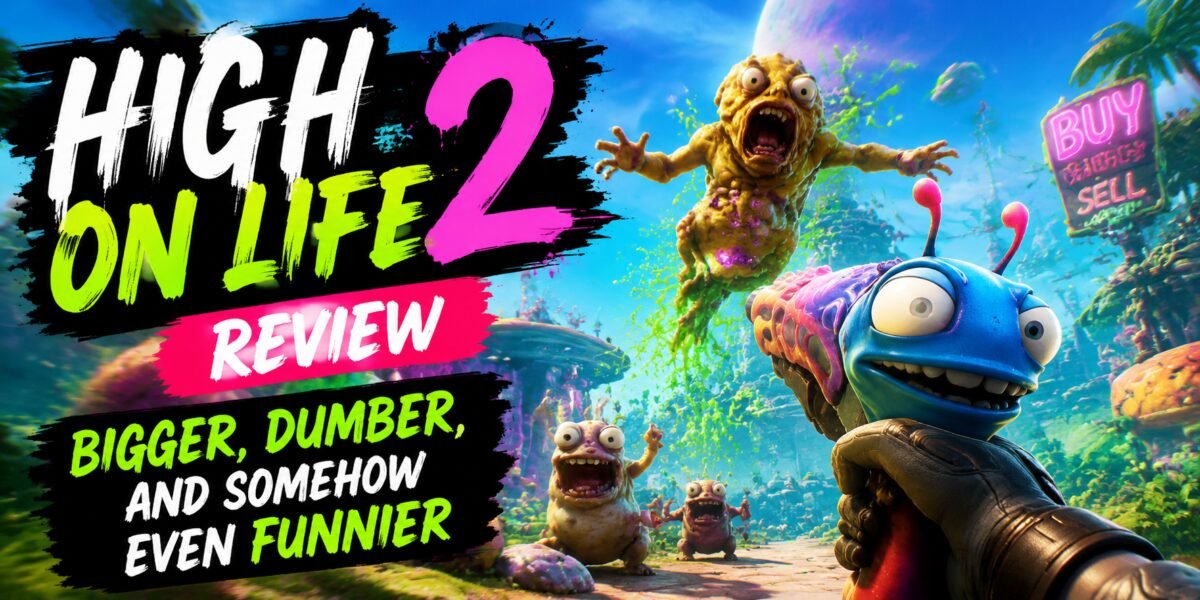
Some sequels play it safe. High on Life 2 responds by strapping a skateboard to your talking gun and shoving you off a cliff. Squanch Games’ original outing was a divisive but undeniably distinctive shooter-comedy hybrid, and its follow-up leans harder into everything that worked the first time — bigger environments, more traversal freedom, and a script that somehow finds new, increasingly unhinged ways to make its living weapons insult you mid-firefight.
| Developer | Squanch Games |
| Publisher | Squanch Games |
| Platforms | Nintendo Switch 2 (reviewed), PC, PS5, Xbox Series X|S (later window) |
| Release Date | July 1, 2026 |
| Reviewed On | Nintendo Switch 2 |
| Coedee Score | 8.0 / 10 |
Same Universe, Bigger Playground
High on Life 2 picks up with its unnamed bounty-hunter protagonist back in the saddle, gun-toting alien companions in tow, chasing down a new wave of intergalactic threats across environments that feel substantially more ambitious than the first game’s. Where the original occasionally felt constrained by tighter, more linear level design, the sequel opens up into sprawling alien biomes that genuinely reward exploration — hidden bounties, environmental jokes, and side-content that riffs on everything from prestige sci-fi cinema to reality TV are stuffed into every corner.
The larger environments are matched by a significantly expanded traversal kit. New skateboarding mechanics let you carve through alien cityscapes and canyon systems with real momentum, chaining grinds and boosts in a way that recontextualizes combat encounters entirely — fights that used to be static shooting galleries now sprawl across vertical, kinetic spaces where mobility is as important as aim.
The Guns Are Still the Main Characters
Justin Roiland’s signature comedic voice (by way of the studio’s now well-established roster of writers continuing the tone he established) remains the game’s biggest asset and its most polarizing one. Your sentient weapons — chatty, neurotic, morally dubious — comment constantly on everything you do, and whether that’s a delight or an exhausting barrage depends heavily on your tolerance for rapid-fire absurdist humor. We found the hit rate noticeably improved over the original; jokes land with better timing, callbacks feel more earned, and a few late-game character reveals manage genuine emotional surprise underneath all the crude comedy.
Gunplay itself has been meaningfully refined. Weapon-swapping is faster and more intuitive, each gun’s unique gimmick (freezing, portal-shooting, life-draining) feels more distinct from its neighbors, and encounter design has been reworked to actually force you to use those gimmicks tactically rather than defaulting to whichever gun feels strongest.
Where the Jokes Wear Thin
The elephant in the room remains the same as it was in the original: this is an extremely talky game, and the constant stream of dialogue — while frequently funny — doesn’t always know when to stop. Extended cutscenes and forced dialogue sequences occasionally overstay their welcome, especially during the middle third of the roughly 14-hour campaign, where pacing sags noticeably compared to the tightly constructed opening hours.
On Switch 2 specifically, we noticed occasional texture pop-in during the largest open environments and minor frame pacing hiccups during the busiest skateboard-combat sequences — nothing campaign-breaking, but noticeable enough to mention for performance-conscious players who might prefer waiting for the PC or PS5 release windows.
New Companions, New Chaos
The roster of talking guns and alien sidekicks has expanded meaningfully for the sequel, introducing several new companion weapons whose personalities are distinct enough to actually change how you approach combat encounters, not just how you feel about them narratively. One new addition — a nervous, conflict-averse pistol who audibly panics and tries to talk enemies out of fighting before every encounter — became a genuine highlight of our playthrough, providing a steady stream of increasingly desperate one-liners that somehow never grew stale across a full campaign. Returning companions from the first game get meaningful character development too, with callback jokes and evolving relationships that reward players who finished the original.
The bounty-hunting structure that frames the campaign has also been expanded, with a genuinely wider variety of bounty targets ranging from straightforward combat encounters to elaborate, multi-stage heists that lean into the game’s love of genre parody — one standout bounty riffs extensively on prestige heist-thriller cinema, complete with a fourth-wall-aware “team assembly” montage that had us laughing out loud more than once.
Comparing Notes With the Original
Players who spent significant time with the first High on Life will notice that Squanch Games has clearly taken community feedback seriously. Complaints about overly linear level design, underdeveloped weapon gimmicks, and combat encounters that leaned too heavily on simple bullet-sponge enemy design have all been directly addressed here, with more open environments, more distinct weapon identities, and enemy encounters that increasingly demand you rotate through your arsenal rather than picking a favorite and sticking with it. It’s the kind of sequel that reads as a genuine response to a specific set of criticisms rather than a safe, incremental follow-up, and that willingness to actually change course is a big part of why it lands as well as it does.
Boss Fights and Set Pieces
The sequel’s boss encounters represent a genuine step up from the original’s occasionally underwhelming set pieces. Each major antagonist gets a distinct arena, a unique attack pattern worth actually learning, and — true to form — an absurd amount of dialogue mid-fight that somehow never undercuts the tension of the encounter itself. One standout mid-game boss, a washed-up alien celebrity turned bounty target, alternates between genuinely challenging attack phases and extended comedic monologuing that had our entire review team laughing while simultaneously trying not to die, a tonal balancing act that shouldn’t work as well as it does. The skateboard traversal mechanics get folded cleverly into several of these encounters too, with arena hazards specifically designed around your new mobility options, forcing constant movement rather than the more static positioning combat of the first game.
Exploration and Secrets
Squanch Games clearly put real effort into rewarding curiosity this time around. Hidden throughout the game’s expanded biomes are optional bounty targets, joke-heavy environmental vignettes, and genuinely clever secrets that riff on other games and franchises without ever feeling like cheap reference humor for its own sake. Collectible currency scattered through these secret areas feeds into a genuinely worthwhile upgrade economy for both your skateboard traversal tech and your arsenal, giving exploration a tangible mechanical payoff beyond just more jokes, though there’s plenty of that too.
The game’s structure alternates comfortably between tightly scripted story missions and more open bounty-hunting excursions across its larger hub environments, giving High on Life 2 a rhythm that feels considerably more varied than the more linear mission flow of the original.
Pros & Cons
- + Skateboarding traversal meaningfully transforms combat and exploration
- + Sharper joke-writing with a noticeably better hit rate than the original
- + Larger, denser environments packed with genuine secrets
- + Weapon gimmicks feel more distinct and tactically relevant
- − Mid-game pacing sags under the weight of extended dialogue sequences
- − Minor technical hitches on Switch 2 hardware
- − Humor density will still be a dealbreaker for some players
“It’s louder, ruder, and considerably more confident than its predecessor — a sequel that knows exactly what its fans came back for.”
The Verdict
High on Life 2 is a rare comedy-driven sequel that actually earns its bigger scope. The new traversal systems give combat and exploration a kinetic identity the first game never quite achieved, and the writing — for all its excess — lands more consistently than before, culminating in a back half that surprised us with actual emotional stakes buried under the absurdity. It’s not a game for everyone; the sheer density of dialogue and gag-based humor will exhaust players without patience for it, and pacing issues in the middle act keep it from greatness. But for anyone who bounced off the original looking for more polish and ambition, this sequel delivers exactly that.
Platform Considerations
Given the technical hiccups we observed on Switch 2 hardware, players with access to multiple platforms may want to consider waiting for the PC or PlayStation 5 release windows later this year, where the larger, more visually dense environments are likely to run with fewer compromises. That said, the ability to take the game’s skateboard-traversal sandbox on the go is a genuinely appealing proposition for handheld-focused players, and the performance issues we encountered, while worth flagging, never rose to the level of actively hindering our enjoyment of the campaign.
How Long Is It?
Our campaign playthrough, including a reasonable amount of optional bounty-hunting and exploration but stopping short of full completion, clocked in at roughly 14 hours. Completionists chasing every hidden secret, optional bounty, and collectible currency stash should expect several additional hours on top of that, and given the quality of the game’s writing, we suspect most fans of the first game will find that extra time well spent rather than padded filler. For a comedy-driven shooter, that’s a genuinely healthy amount of content, and it rarely overstays its welcome across the full runtime, even when the jokes occasionally do, and that balance is ultimately what makes the sequel worth recommending.