


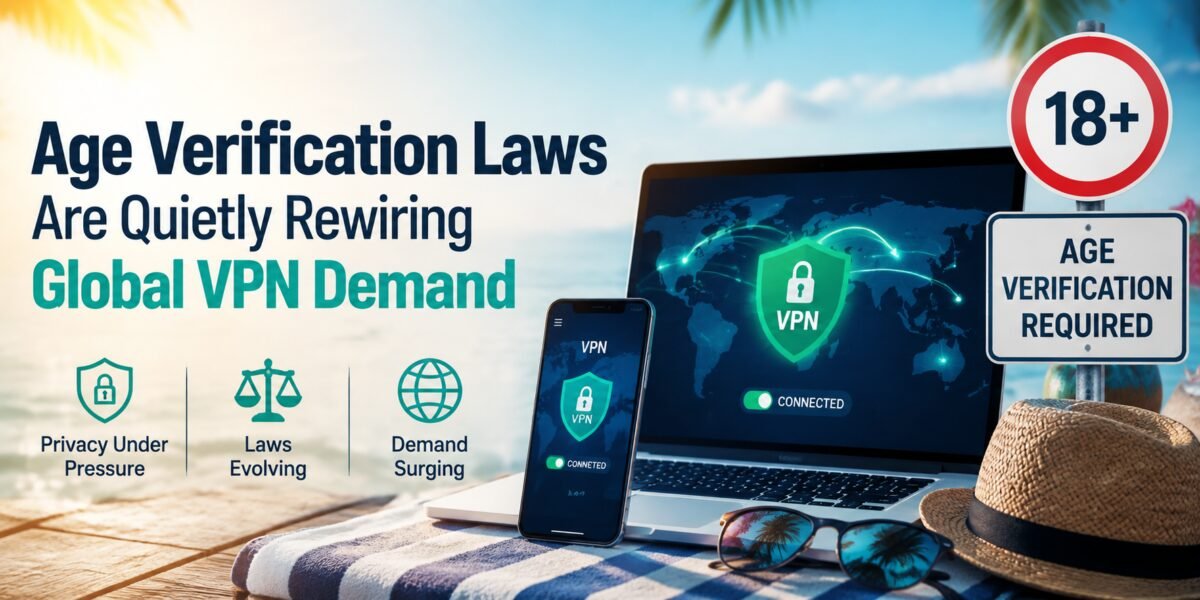
VPN adoption has always risen and fallen with the news cycle — spiking around elections, major streaming releases, or high-profile data breaches. But the driver behind the most sustained recent surge in VPN interest isn’t any single event. It’s a slower-moving, less flashy trend: a growing wave of age-verification laws and platform-access restrictions being rolled out by governments around the world.
What’s actually changed
Over the past couple of years, a growing number of countries and jurisdictions have introduced laws requiring platforms to verify the age of their users before granting access to certain content or services. These range from adult-content age gates that require some form of ID or age-estimation check, to broader social media restrictions aimed specifically at minors. Australia’s social media restriction for under-16 users is one of the most talked-about examples, requiring major platforms to take active steps to keep younger teenagers off their services entirely rather than simply gating specific content categories.
The policy goals behind these laws are generally understandable and, in many cases, popular: protecting children from harmful content, curbing the well-documented mental health effects associated with heavy social media use among teenagers, and giving parents more confidence that platforms are taking age restrictions seriously rather than treating them as a checkbox during signup.
The practical side effect, however, has been a measurable jump in VPN interest — not necessarily from the teenagers these laws are aimed at, but from a much broader population of users who are uncomfortable with the verification methods being used to enforce them.
Why age verification pushes people toward VPNs
Age verification systems generally rely on one of a few methods: submitting a government ID, undergoing facial age-estimation scanning, or linking accounts to credit cards or other identity-proving services. Each of these approaches solves the stated policy problem in a narrow sense, but each also creates a new privacy trade-off that a meaningful number of adult users simply aren’t willing to accept.
Handing a government ID to a website, even one that promises not to store it, requires trusting that promise completely — a trust that’s been repeatedly tested by data breaches at companies that made similar assurances. Facial scanning raises its own set of concerns about biometric data collection. And tying access to a credit card, beyond simply excluding people who don’t have one, creates a permanent, traceable link between a person’s real identity and the specific content or platforms they access.
For a lot of users, a VPN offers a simpler way to sidestep the entire dilemma: by routing their connection through a server in a jurisdiction without the same verification requirements, the age-gate never triggers in the first place. Whether or not this is the outcome lawmakers intended, it’s become one of the most consistent, predictable drivers of VPN sign-ups anywhere a new verification law takes effect.
Every time a new age-verification law takes effect, VPN providers report the same pattern: a sharp, immediate spike in sign-ups from the exact region the law was written for.
A pattern that keeps repeating
This isn’t a one-off phenomenon tied to a single country. It’s become a recurring pattern: a jurisdiction passes or enforces an age-verification requirement, and VPN providers see a corresponding jump in traffic and sign-ups from that region almost immediately. It’s predictable enough at this point that VPN companies’ own public commentary and marketing teams have started treating new age-verification legislation as a near-guaranteed demand event, the same way retailers plan around a holiday shopping season.
What makes this trend different from past VPN demand spikes is its durability. A surge tied to a single streaming release or a single news event tends to fade within weeks. A surge tied to a permanent regulatory change doesn’t have an obvious expiration date, because the underlying law isn’t going away. As more jurisdictions introduce similar requirements, the aggregate effect compounds rather than resetting.
The tension regulators haven’t fully resolved
There’s a genuine policy tension buried in all of this that hasn’t been resolved by any government that’s tried to legislate around it so far: age-verification laws are, almost by design, most effective against people who comply with them in good faith, and least effective against the people determined to route around them — whether that’s a tech-savvy teenager who knows how to use a VPN or an adult who simply objects to the privacy trade-off on principle.
Some regulators have started exploring VPN-specific countermeasures, though enforcement at that level is a genuinely difficult technical problem — blocking VPN traffic at scale runs into the exact same obfuscation and detection arms race described elsewhere in the VPN industry’s current news cycle, and it risks collateral damage to legitimate, non-age-related VPN use like corporate remote access and general privacy protection. So far, no jurisdiction has managed to close this loophole in a durable way, and there’s little indication one is close to doing so.
What this means if you’re evaluating a VPN right now
If age-verification laws are part of why you’re looking at VPNs for the first time, a few things are worth keeping in mind that go beyond simply picking a server location:
- Read the terms of service of the platform you’re accessing, not just the VPN. Some platforms explicitly prohibit using a VPN to bypass age or region restrictions, and violating those terms can carry consequences separate from anything related to the VPN itself.
- Understand that a VPN changes your apparent location, not your legal obligations. Laws in your actual jurisdiction still apply to you regardless of what server you’re connected through.
- Prioritize providers with a genuinely audited no-logs policy. If privacy is the reason you’re avoiding an age-verification system in the first place, it defeats the purpose to hand that same data to a VPN provider with weak privacy practices instead.
- Consider why you’re uncomfortable with the verification method, specifically. A VPN solves the immediate access problem, but it doesn’t address the broader question of how comfortable you are with ID-based verification becoming a more common part of using the internet generally — a trend that shows no sign of slowing down.
The platform side of the equation
It’s worth remembering that platforms themselves aren’t passive bystanders in this dynamic — they’re the ones legally on the hook for enforcing age-verification requirements, and many have started deploying their own VPN-detection systems as a direct response. This creates an unusual three-way dynamic: regulators pushing platforms to verify age, platforms building detection systems to catch VPN traffic attempting to route around those checks, and VPN providers building obfuscation technology to stay ahead of that detection. It’s a smaller-scale version of the same obfuscation arms race playing out around state-level censorship, except the party doing the blocking here is a private platform responding to legal liability rather than a government pursuing an ideological or political goal. The incentives are different, but the underlying technical cat-and-mouse dynamic is strikingly similar.
Not every VPN user avoiding age checks is who lawmakers picture
One detail that tends to get lost in coverage of this trend is just how broad the population using VPNs to route around age verification actually is. It’s not simply teenagers trying to access age-restricted platforms, which is the use case most directly targeted by this kind of legislation. A large share of the affected users are adults who are perfectly eligible to access the content or platform in question, but who object on principle to handing over a government ID or submitting to facial scanning just to prove something that shouldn’t require surrendering that much personal data in the first place. For this group, the VPN isn’t a tool for evading a restriction they’re not supposed to get around — it’s a tool for accessing something they’re already legally entitled to, without the privacy cost regulators have attached to that access.
Frequently asked questions
Is it illegal to use a VPN to get around an age-verification law? This varies significantly by jurisdiction and by the specific platform’s terms of service, and it’s genuinely worth checking the rules that apply where you live rather than assuming. In many places, using a VPN itself isn’t illegal, but it may violate the terms of service of the specific platform you’re accessing, which can carry its own separate consequences.
Do age-verification laws actually reduce the amount of restricted content minors can access? This is genuinely disputed, and it’s a big part of why the topic remains politically contentious. Critics point to the ease of VPN circumvention as evidence the laws mostly inconvenience compliant adults rather than the population they’re aimed at; supporters argue that even partial friction reduces access meaningfully compared to no barrier at all.
Will more countries pass similar laws? Recent trends suggest yes. Lawmakers in multiple jurisdictions have cited existing age-verification and social-media-restriction laws as reference points while drafting their own versions, suggesting a degree of policy contagion likely to continue.
The bigger picture
Age-verification legislation is unlikely to slow down in 2026 and beyond — if anything, more jurisdictions are actively drafting similar laws, often citing existing examples as a template. That means the VPN demand pattern tied to this trend isn’t a temporary blip; it’s shaping up to be one of the more durable, structural drivers of VPN growth the industry has seen in years, alongside more familiar motivators like streaming access and general privacy protection.
Whether that’s a good outcome for the stated policy goals behind these laws is a separate question entirely — and one that regulators, platforms, and privacy advocates are likely to keep arguing about long after the current wave of legislation has passed.